ADSX: Day Five
Rule No. 4: Always Stop for Coffee

I awake to a framed black-and-white photograph at the foot of the bed in the guest room of John’s house. The image is of Carswell Grove Baptist Church near Millen, which John took years ago. It is evocative and moody, and the weathered wooden church seems to blend into the dramatic, cloudy sky behind it. Southern and gothic and definitely haunted by something—if not Jesus, then someone else.
Just as we did seven years ago, we stop first at Buona Caffé a block from John’s house for coffee. The last time we did so turned out to be an auspicious and even prophetic beginning to a transformative journey towards the Mississippi Delta. It went like this:
2018: Heading east out of Augusta on Central Avenue, we are not a block into the trip before I need to stop. I know it could be a while before we see another decent cup of coffee, so the early pit-stop at the Buona Caffé in Augusta seems well-advised.
I leave the car running, because it's already hot as it's supposed to be in Georgia in July, and pop inside to place my order with the barista.
Now, I have a background in theology and an amateur interest in southern history and a bit of an obsession with the poet Dante Alighieri, and John is a professional historian who's written on race and religion in the south. While he's brewing the previous customer's beverage, the barista asks what brings me to town. I try—for the first time over the next two weeks—to explain this strange journey we are on. It comes out like a very poorly-rehearsed elevator pitch, all ragged-edged and semi-coherent, but he manages to get the gist.
I'm a seminary student, he tells me, doing a thesis on race and religion. It's on Howard Thurman, King, and Thomas Merton, he says.
No way, I say. Hang on a sec, I tell him. There's someone you need to meet.
I drag John out of the minivan, which already sounds like it's overheating. Back inside the Buona, John tells the barista he lives around the corner. We really should chat, he says, and they make plans to do that when he is back in town.
I give the barista my card, and scrawl onto it the name of the hastily-made instagram account we made for the trip because that's who we are now. We say thanks for the coffee, and promise to be in touch.
Not much later, on US 1, John interrupts his dramatic reading of the WPA Guide to Georgia to respond to an alert on his iPhone (also who we are now).
"Hey, he followed us," John says.
"Who?" I ask.
"Dante," John says. "The guy from the coffee shop."
"His name is Dante?"
"Apparently."
"And we are just getting ready to go on a quest deep into the Southern inferno?"
"His name is Dante."
"That does not seem like an accident."
2025: We are barely inside the front door of Buona when an African-American woman at the round high-top in the window recognizes John. Her name is Karen. She hasn’t been to Buona in the longest time, she says. But she was supposed to meet someone at a place across the street, and figured she would pop in here for a coffee. Karen is a jazz performer, a vocalist and pianist, who organizes the jazz portion of a local arts festival in September. I tell her my son is a jazz trumpet player and multi-instrumentalist. A connection is made. Possible plans are hatched. A small world is created.
I text Henry to tell him about the festival, and ask him if he knows Karen’s brother, a well-known jazz trombonist. He does. The already small world constricts even more.
We talk with Karen about Helene, a disaster that dramatically affected both Augusta and Asheville, which are both still struggling to right themselves. It is a kind of living absence we hold in common. Both cities are still marked by scores of uprooted trees, clay-clotted root-balls exposed ass-up. It is almost indecent; trees are not supposed to be seen this way. It’s like accidentally catching someone in the middle of changing clothes, or seeing a peacock from behind.
nothing can be possessed except the struggle
tiny, invisible molecular moral forces that work from individual to individual, creeping through the crannies of the world like so many rootlets
These molecular forces are at work at the present moment in the Buona, a cafe named with the Italian word for “good.” A particular favorite of the great Italian poet Dante, along with fortuna, which he understands as a kind of divinely-ordained power. If Dante had needed genie-souls, he would probably have treated them as emissaries of fortuna. But he did not; he had Virgil.
In my case, I have John, who leads us down a side road off of US 25 north of Millen to a wide rectangular expanse cut into the dense pine forest. At one end is a sparsely populated graveyard; at the other a newish church building. It appears constructed out of cinder blocks or something similar. It does not look especially historic.
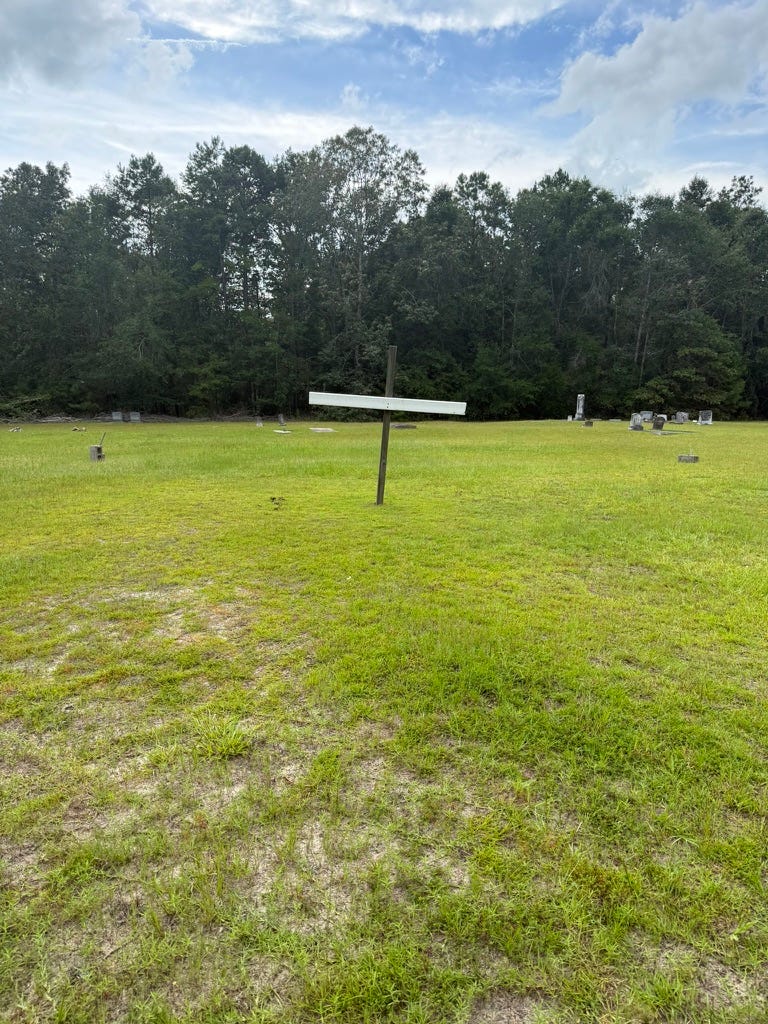
It is what is in between the current church building and the graveyard, however, that has drawn us here. There is nothing in this interstitial zone, just a close-cut grassy space marked by regularly-spaced cinder blocks. At one end, on the side nearest to the road, is a historical marker, which tells how the church was formed in 1867 as an offshoot of nearby Big Buckhead Church (still standing) when Black parishioners left Big Buckhead, moved down the street, and built their own church there. The most important passage reads:
On April 13, 1919, the church was destroyed by arson during an outbreak of racially-charged community unrest. Fueled by social changes following World War I, the incident was part of "The Red Summer," eight months of nationwide racial violence impacting over two dozen cities - including Chicago and Washington, D.C. Following the 1919 unrest, Carswell Grove was rebuilt. To accommodate the church's growth, an updated church facility was erected in 2008 adjacent to the historic structure. Listed on the National Register of Historic Places in 1996, the historic 1919 building was destroyed by arson in 2014.
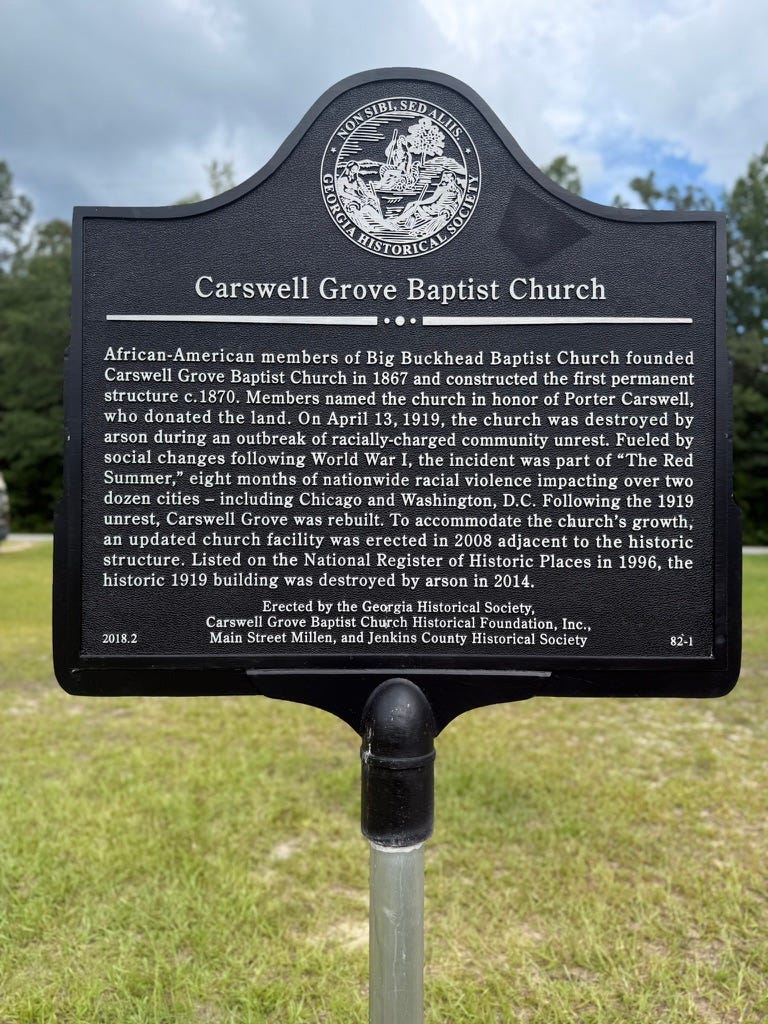
"Memory believes before knowing remembers,” Faulkner famously wrote. “Believes longer than recollects, longer than knowing even wonders.” That virtually impenetrable passage from Light in August might be beginning to make the faintest shimmer of sense for me as John points out that, even though this marker comes with the imprimatur of the Georgia Historical Society, it has left out some significant details. The marker was erected the same year we were having coffee with Dante, in 2018, well after the time historical markers started to become less cagey with the more disturbing parts of their subject matter.
The most glaring of those omissions on this one is that the line “destroyed by arson” conceals the fact that the conflagration took place as part of a lynching. It followed the usual pattern: an innocent Black man is accused of a crime against a white person, and a furious mob of white men tear off in search of him. Except in this case, the mob never found their man. Instead they set fire to the church, captured his two sons, and threw them both onto the pyre. This grotesque display of white violence was the initial spark of the Red Summer of 1919, the first in a protracted series of deadly outbursts that would claim hundreds of Black lives and permanently scar American history.
These events are practically galactic in their import. But as I am slowly learning, there are less visible forces in motion here, too. Molecular moral ones. Joe Ruffin, the man initially accused of the killing of two police officers that set this episode in motion, was jailed for a time, but ultimately freed in 1923. His grandson, The Honorable John H. Ruffin, Jr., became the first Black chief judge of the Georgia Court of Appeals. It’s a better image than the mythological phoenix Atlanta uses for its self-image as “risen from the ashes.” In this case, an actual human life—somehow, somewhy—rose out of literal ashes to become an agent for the justice that his own grandparents were denied.
John fills in these crucial details for me in a way the marker will not. The church that he captured in a photograph is no longer there. In its place an empty field marked off by cinder blocks.
All that remains: an absence held in common.