

ADSX: Day One
Augusta to Milledgeville, by way of Crazytown

[Caveat scriptor: These daily updates are more than likely going to be composed from the bed of an anodyne and prosaic corporate hotel, in a road-addled and heat-draggled condition that loosens the conscience to the point where it is OK with making up words like “heat-draggled.” They will be either too short or too long, not obsessively edited nor adequately polished, and will almost certainly contain something to irk some scholar somewhere. But they will, I hope, faithfully reflect the spontaneous and slightly reckless spirit of discovery that animates these trips. Cheers!]
It’s just shy of 11:00 pm, and we have just settled into what appears to be the only remaining hotel room in Milledgeville, Georgia. “Sold Out” is not a term one typically meets with in Milledgeville, but on this particular evening, some strange set of coincidences has apparently driven much of the country to this otherwise not-particularly-congested place, and “Sold Out” is the refrain du jour. Never seen anything like it, we have heard more than once, most recently from the Indian-American Milledgeville native who gave us the present room at a hefty discount, as compensation for the malfunctioning air-conditioning unit, which is currently unplugged and partially dismantled beneath the window that faces the unusually full parking lot.
It’s not the first time that this first day of our tenth tour has felt reminiscent of our very first tour together in August 1997, conducted in a 1977 Ford F-150 also without air conditioning, when the summer air in south Georgia was so thick you had to chew it, and when a perpetual layer of sweat covered you like a mucous membrane to insulate you from the threat of comfort. I have taken to calling this “the sheen,” which is impossible to prevent and useless to fight. Today the climate was similarly thick and chewy, the temperature somewhere in the mid-nineties, but the heat index somewhere in the middle thousands.
The pace was slower than usual this time, by design: after about six hours of meandering west from Augusta we had made it only about twelve miles, but that short distance was disproportionately packed with surprises. That, as we have learned, is the general formula of these road trips: the slower you are willing to move, the more willingly the genie-souls of the roadside seem to offer themselves to you.
Case in point: the first unintended stop was a dilapidated, vine-encumbered, Victorian-looking brick building not far from where we started this morning. The lawn had been mown recently, which suggests that someone has not entirely given up on this property. As it turns out, the building was erected in 1902 as St. Benedict the Moors Industrial School, in the historically Black Laney-Walker district of Augusta. I’ve encountered Industrial Schools many times, most notably (for me) the Okolona Industrial School in Okolona, Mississippi, founded by Wallace Battle in the same year. But I have never seen one named for a saint, and this is a saint I have never heard of.


For a while now I have been fascinated by the history of Black Catholics in the South, not least because they don’t fit neatly into the pre-established demographics we understand far less than we think we do: Black, Catholic, Southern. Their history has been written about by scholars, but it is not especially well-known. They hold the distinction of being able to trigger the Klan for two reasons. They remain enigmatic and provocative in ways that also undermine the received narrative of Southern (and/or American) religious culture that tends to favor a quasi-monolithic white Baptist version of things). They also gesture towards an alternative history that could have been, but was not. I admit I know nothing whatsoever about the causes for the demise of St. Benedict’s, but it had something to do with the confluence of the consolidation of Catholic parishes, desegregation, white suspicion, and so on.
But whatever the story of St Benedict the Moors (and the connected Immaculate Conception Chapel, built in 1906) turns out to have been, it is salutary for having introduced (to me, at least) the figure of Benedict the Moors, also known as Benedict the Black, an Afro-Sicilian Franciscan friar in the sixteenth century, who was born into slavery in Sicily in 1624, and freed at the age of eighteen. Benedict’s life was devoted to humble service of the poor. If nothing else, it has added to the inventory of memory an exemplar of moral virtue, a model of humility, and a life that showed Black Southerners during Jim Crow there is an otherwise mode of being. And not just Black Southerners; also me.
It was salutary, certainly serendipitous, maybe even providential, to encounter Benedict in this way at the very beginning of this trip. I have been thinking a lot recently about the discourse around “Christian nationalism,” about which I have many thoughts, but which has unfortunately dominated and possibly overdetermined the anguished discussion and perception of Christianity in America at the moment. And for good reason. What we are calling Christian Nationalism is driven in part by a culture of celebrity that poisons everything it comes into contact with, including religious life. There is a certain genre of celebrity Christian that is a priori untrustworthy: that sort of highly visible individual who speaks the “right” language and makes the “right” gestures, but whose actual life and the relationships that constitute it is ultimately immaterial to their public persona. A life whose shape could be plausibly narrated without any reference to Jesus of Nazareth. The opposite, in other words, of Benedict the Black. He is called a saint because, like all saints, his life really doesn’t make any sense apart from its reference to the shape of the life of Jesus.
Even the Minister General of Benedict’s order, the Order of Friars Minor, believes that his life is “not sufficiently well known,” as he put it in a letter last year marking the 500th anniverary of Benedict’s birth. But perhaps that is as it should be. His life seems to embody the sense of the famous passage by George Eliot, that “the growing good of the world is partly dependent on unhistoric acts; and that things are not so ill with you and me as they might have been, is half owing to the number who lived faithfully a hidden life, and rest in unvisited tombs.”
Lives like that—and the communities that shape them—are at least one of the things that I am keeping my eyes and ears out for this time around.
It is now well after midnight, and therefore Tuesday, and I have gone on too long, but that is the way of it. I have much more to share with you, but it’s past your bedtime. Here are a few photos from the day, which I can explain later:


Finally:
Perhaps you think I am blowing hot air when I go on about all these unexpected convergences I refer to, am being fanciful about this “mysticism of the Southern road” and all that. So I will leave you with one final item.
Earlier today, we stopped in Warthen, Georgia, a tiny hamlet known for almost nothing apart from the fact that it is home to the oldest wooden jail in the state, built in 1783, which allegedly held one Aaron Burr for a night in 1807 while en route to Richmond to be tried for treason.
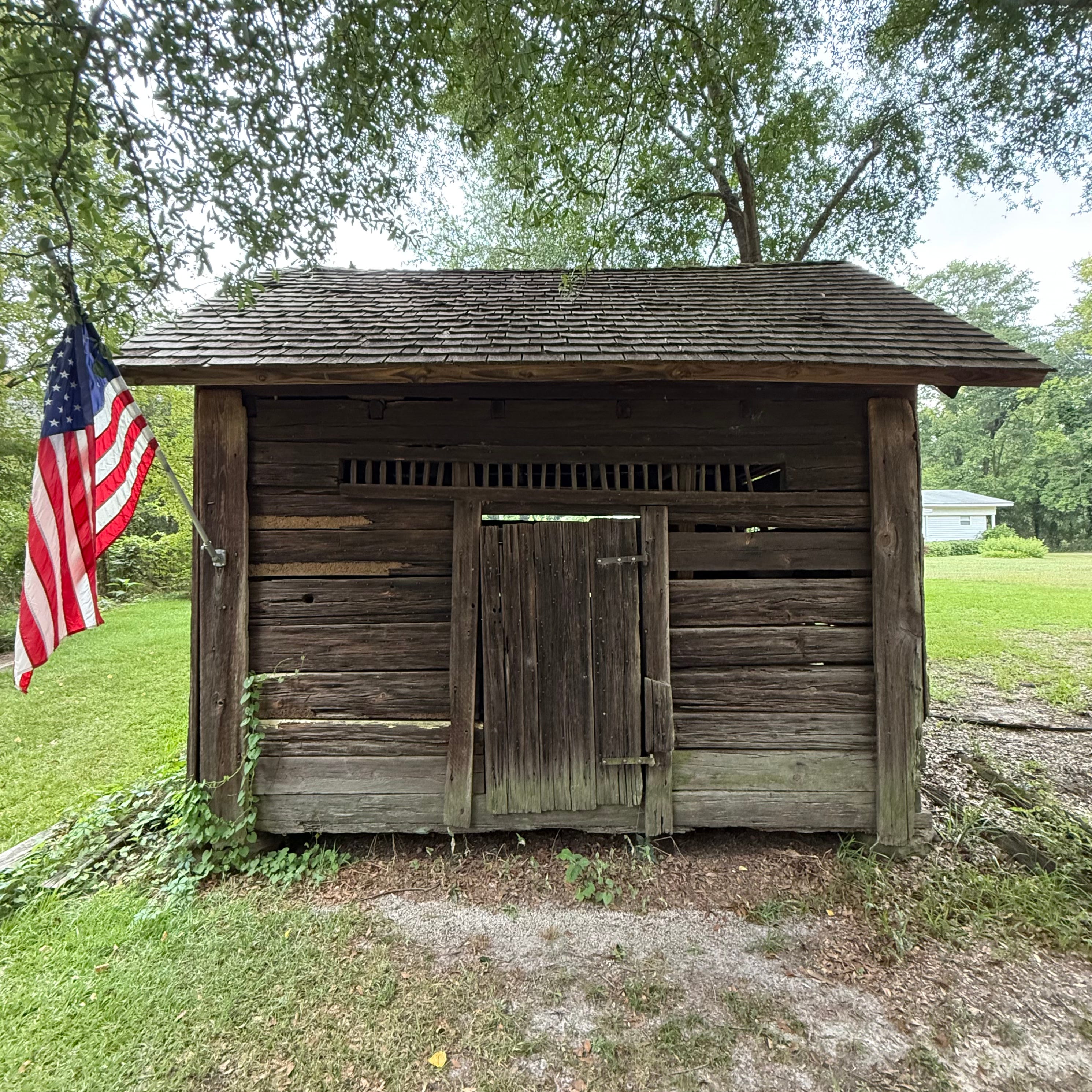
Just before dinner tonight at Bollywood Tacos on Hancock Street in Milledgeville, I get an email from a stranger who has seen Jasmine’s Boyfriend—the Deeper South van—in Warthen, looked me up, and written to me. (I have a number of wild stories of this kind; more on that another time.) It’s good enough to share the whole thing, which I will do if I can get the sender’s permission. But the kicker of the message is when he tells me that his mother’s sister was married to “John S. Candler of Atlanta.” He means not The Judge but The Judge’s grandson, John S. Candler II, my grandfather’s brother. Uncle John. He also names a number of other people that he is related to. The emailer doesn’t (yet) know that I know all of these people, grew up with them, share DNA with them. He definitely doesn’t know what I am just realizing: this random guy I have never met but who saw my van is somehow my cousin.
See what I mean?