

ADSX: Day Three
Radical Contingency in Johnson County

When we emerge this morning from the anodyne and prosaic corporate hotel, it is not once more into the bright world to see the sun and the other stars, but into the comprehensive greyness of a typical summer afternoon thunderstorm that has arrived about six hours too early. Everything feels upside-down or at the very least off-center. Which is entirely apposite, since the anodyne and prosaic corporate hotel faces Andalusia across US 441, the final home of Flannery O’Connor, who cannot accurately be described with any of those adjectives.
By the time we cross State Road 57 south of Toomsboro on State Road 112, the gullywasher has subsided, but the clouds still project a general attitude of tumult. About a mile past the intersection, I impulsively yank the van onto the shoulder in response to a large roadside cross, festooned with what looks like bunting and inscribed with JESUS SAVE ME in red, white and blue. Jasmine’s Boyfriend finds a rain-saturated gulch off the shoulder and slowly begins to sink into it on the starboard side. It leans perilously toward the embankment, and the back tire is airborne. Within ten minutes, a kind gentleman—either an angel of the roadside or a genie-soul incarnate—has stopped and pulled J’sB out of the slough.
All four tires once again touching the ground, we resume our search for Freedom, Georgia, originally a roughly 100-acre parcel of land south of Toombsboro purchased by a collective of Black families. Following the murders of George Floyd and Ahmaud Arbery in 2020, the families bought the land with the intent of establishing a sort of sanctuary community for people of color, a kind of Mound Bayou for the 21st century, free from white violence. It is somewhere in a general area on the map, but we are unable to locate it. Later, as I dig a little deeper into the Freedom story, it’s not clear it’s still a going concern.
But it’s an inspiring project nonetheless, in a part of Georgia that seems fertile for experiments in intentional community, where genie-souls are unusually active.
A week ago, I participated virtually in a book group discussion of A Deeper South hosted in Athens by my friend Merryll. I mentioned at the end of the zoom session that I was about to set out on another road trip, and mentioned what I thought I might be looking for this time. The following day, one of the group’s members wrote to me with some suggestions about Louisville, Georgia, an hour southwest of Augusta. She mentioned Louise Abbot, who had been a friend and correspondent of O’Connor’s. As it turns out, John and Louise had been in contact with one another for a number of years, and John had played for me some of Louise’s messages on his voicemail, delivered in her inimitably mellifluous middle Georgia accent. She also mentioned a retreat center near the town of Adrian, called Green Bough House of Prayer.
So having abandoned our failed search for Freedom, we continued southwest toward Green Bough. We passed it on the first approach, because it is both unmarked and virtually indistinguishable from any other cluster of homes in middle Georgia. The only real sign that it is not any other cluster of homes is a bank of solar panels in an adjacent field.
Alighting from the van, we are met almost immediately by Oliver, a resident of the community who initially mistakes us for members of the wedding party who will be descending this weekend. What is A Deeper South, he asks. I give a short, semi-rehearsed answer that misleadingly implies that I know the answer myself, but he nods genuinely and slowly in a way that convinces me he knows better what it is than I do. Oliver is about to have lunch, and invites us to join him. Having just had street tacos at a Mexican mercado in Dublin, we pass on lunch but do join him for conversation about Green Bough. We sit together at the circular dining table in the kitchen of what was the original house on the property, where the founder of the community lived for years. It now serves as the mess hall, office, storage. Its foyer is a bookshop with hundreds of titles in theology, the contemplative life, botany, race, and so on. Some of them are very familiar, some are not, but they are all inviting.
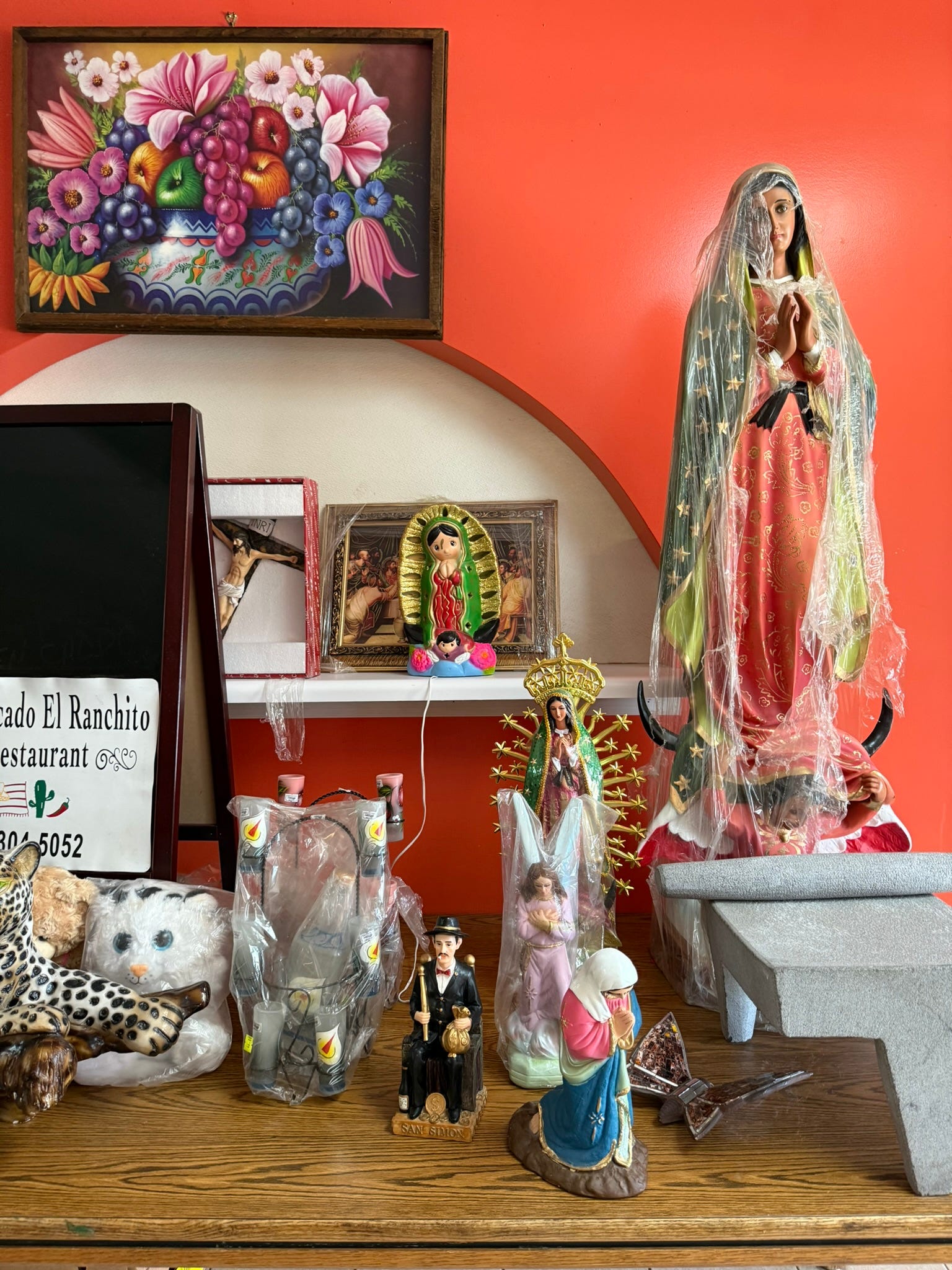
The story of Green Bough goes back to its founder Fay, who has just left with her co-founder, Steve, to go into town for some necessities. Oliver walks us around the property along with a recently-adopted puppy, Frankie, and tells us about the regular cycle of retreatants and the loosely Benedictine rule of life that the community at Green Bough—and its many associated oblates who live elsewhere—vow to commit to. Life here follows a liturgical order—morning prayer, the Angelus at noon (signaled by a bell rescued from a decommissioned nearby church and housed in a wooden tower designed and built by an illiterate friend of the community), evening prayer, Eucharist. The charism of the community is a marriage of contemplative Catholicism and Wesleyan practices of the heart, and the chapel of the retreat house features a large cross made by an Orthodox iconographer from Augusta out of recovered floorboards from a local tobacco barn. He walks us to the labyrinth, which began about fifteen years ago with a push lawn mower regularly carving out from the grass a pathway. Over the years the negative spaces where the path of the labyrinth was not have become positive spaces of their own, as volunteer oak, birch, pine saplings have grown up to form those peculiarly life-giving kind of borders that paradoxically limit, direct, and liberate at the same time.
Oliver and I talk as if we have known each other for years. The conversation feels, like the wild and unkempt pasture sections of the Green Bough grounds, saturated with generous light. As we near the end of the path, he answers his cell phone, with apologies. It is Steve. He and Fay have returned. They ask about the visitors with the big van. No, Oliver tells him. I thought the same thing. They are not from the wedding party.
Back in the kitchen, we meet Fay, who is now 83. She greets us with a hug. A major topic of conversation quickly becomes Louise Abbot, a regular visitor to Green Bough and a dear friend of Fay’s. Fay radiates the kind of capacity for joy that perhaps only monastics really know in this way: as the fruit of an unceremonious yet celebratory commitment to a vocation, a discipline of the heart to tenderness and the giftedness of all existence, and learned resistance to the temptation to take oneself too seriously. Chesterton famously said that angels still fly because tehy take themselves so lightly. A place-specific gloss on Chesterton out here, where songbirds flit from birch to longleaf, might be that birds fly because of resistance, the resistance of air.
In the past decade or so, I have often heard the argument that reading fiction can facilitate the experience of empathy for characters in a story, and thereby inculcate in a reader the capacity for empathy with actual human beings. It’s a lovely idea that also just happens to be true, and even confirmed by multiple scientific studies.
But the experience at Green Bough today proved something even better than that. Reading fiction can make you more empathetic, sure, but it can also actually generate new relationships with other human beings. )Non-fiction or poetry can, too, for what it’s worth.) The whole Deeper South journey began with an experience of reading an author who so categorically upturned my way of seeing reality that I had no choice but to continue to seek out within the lived world vestiges and possibilities of her way of seeing.
And here’s the thing. Today was not supposed to have happened at all. A stop in Scott, Georgia is the result of another series of radically contingent events that did not have to come about, much less together. I know Merryll because of books. I heard about Green Bough because of how someone responded to my own book, and when I got there I met an incredible group of people who had also written their own books.
But this isn’t really about books, in the end: it is about the reason people write books in the first place, or write letters to their authors, or host book groups: to communicate an experience of being human to another person, to establish a connection with another through language, to carve out in the midst of the weedy wilderness of this world a meeting place. The relationship between Louise Abbot and Flannery O’Connor is itself—like every intersection of two or more unique routes of human existence—the creation of a potentially infinite set of new relationships. The paths that led from Flannery O’Connor to Louise Abbot, through who knows how many other intermediaries, to Fay to Oliver and to me: it all contributes to a speechlessness the reigns for several miles after we pull ot of Green Bough.
Hours later, we park Jasmine’s Boyfriend at the curb in front of 207 E. Charlton Street in Savannah, the house where more than just Flannery O’Connor was born.

My daily quotes from Fred Buechner align with your journey in striking ways. I’ll share only one because it is a compliment you deserve. “THE WRITERS WHO get my personal award are the ones who show exceptional promise of looking at their lives in this world as candidly and searchingly and feelingly as they know how and then of telling the rest of us what they have found there most worth finding. We need the eyes of writers like that to see through. We need the blood of writers like that in our veins.”
I'm glad to have these thoughts on radical contingency. I have spent so much of my life, as a classicist, in encounter with something like the opposite way of thinking about our lives, that I get a boost from reading your essay. It would be interesting, would it not, to discuss O'Connor's fiction within that framework. (If I remember correctly, the classicist and O'Connor friend Robert Fitzgerald oversaw her introduction to Greek tragedy.)
I will share an anecdote about my mother and FOC that can be enlisted as another example of that contingency. At the end of her first visit to Andalusia, Flannery walked Louise to her car and said to her, "I hope you'll come back as often as you can." As we all know (you, John, and I), that was not something she said to most people. The two young women hit if off — not inevitably, but contingently and happily.