

Katrina: The Final Season
The last time a newspaper really mattered, and the heroes who knew it did

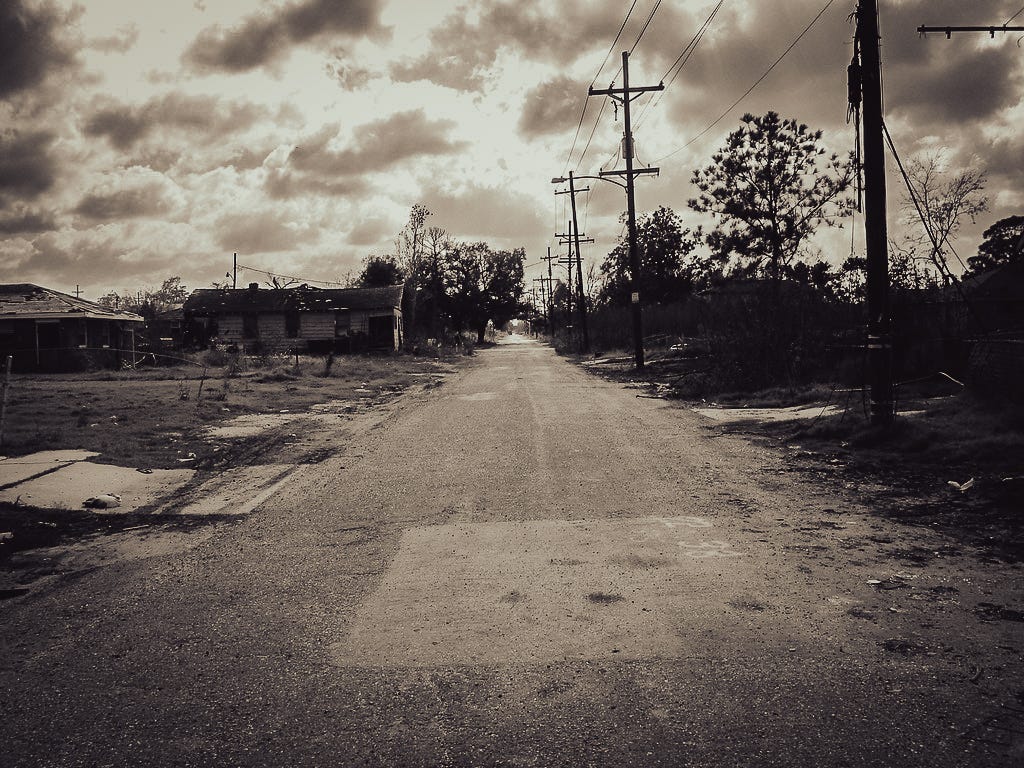
It was two decades ago now. The thick, special edition of the Sunday Observer newspaper weighed into the faux-leather of the empty seat between me and my friend Michael. The dateline on the right side stood out with ominous boldness: September 4, 2005.
“Hot off the press” was the expression then, which hung around in common usage for a few more years, until it became an empty metaphor. Newspapers are produced now with neither heat nor pressure, but with cold, digital dispassion.
But not then. In late August and September 2005, writers and photographers for the New Orleans Times-Picayune waged a daily war for truthfulness, at great personal cost. They approached their task with the entrenched resilience of a cavalry regiment. As the waters rose, the local paper hastily moved operations upriver to Baton Rouge, but an intransigent team of journalists refused to evacuate. They holed up on the third floor of the Times-Picayune building on Howard Avenue, bunkered on the floor and kept writing, ventured out in john boats embedded with SWAT teams, shot photographs, sometimes armed. Delivery trucks plowed through three feet of floodwaters and storm surge just to tell a story of people clinging to a water-logged porch post, clinging to life. They gave out papers by hand to people who needed those stories, who grasped at them like fresh water. It was heroic. Almost as heroic as the three men and one woman who dragged five children in a red Rubbermaid storage bin up the river on Broad Street that was not supposed to be there. It was what journalism is all about: honesty, industry, risk, truth. It simply showed humanity at its most desperate and most transcendent, sometimes at the same time, and tried to give words to it. It was the best a newspaper could ever be.
Amidst the worst tragedy ever to strike that great American city, it was also the last gasp of desperation for The Times-Picayune. In a way, the storm was the best thing to happen to it. For years, the paper had been drowning, too. Katrina had strangely saved the newspaper, for a while. Pulitzers were spread around a year later. Seven years after the flood, though, it succumbed to layoffs, budget shortfalls, outsourcing, and publication was cut to only three days a week. Many of the courageous reporters and photographers who worked for the Times-Picayune were gone, and the life of the paper ebbed away. Its inevitable fate was that of many lesser papers, whose local moments of incomprehensible tragedy never came.
But in early September 2005, it seemed every one was reading the newspaper. In other cities, it may have been The New York Times or The Plain Dealer or Le Monde, but the source was always the same. This was before the little devices with the bluish light started to appear. For one final season, people in every city hung on the words and pictures of a small-market newspaper staffed by men and women who pursued stories of devastation and dereliction with ruthless ferocity. They told and showed stories of excruciating displacement, loss, and suffering, but they suffered and lost too. It was their city also. Every other newspaper outlet at the time handed itself over to others, and carried stories from Times-Picayune staff, whose names were, for a moment, known everywhere.
In a jetliner bound from England for Texas I sat in silence that Sunday, interrupted periodically by my own grunts of disgust or gasps of horror or the flight attendant stopping by for “Coffee? Tea? Biscuit?” Occasionally those grunts would expand into a half-formed thought, but not for long. Always reemerging from under the shrill surface of distraction, like the inexorable low hum of four Pratt & Whitney turbofans, were stories of the admixture of bureaucratic incompetence, neglect, and natural catastrophe—and the stories of light in the dark, of the irrepressible human urge to hold fast, to bind up the wounds of a broken neighbor, a broken city. I had the sense of holding in my hands a monument. It was as close as the newspaper ever came to literature, where the veil between storytelling and editorialism became diaphanous, transparent. It wasn’t necessary to layer on critique: the story itself was critique enough. The journalists seemed to write as if, bereft of theory or high-minded meta-discourse and emptied of all technique, they didn’t know what else to do but simply say what they saw but did not recognize.
It’s a strange business, I thought at the end of an article about a woman who stayed on her roof for three days before being rescued by canoe. The newspaper needs tragedy to make money. It thrives on it. Don’t get me wrong: I love the newspaper as much as anyone, maybe more. It’s a beautiful thing. A beautiful, blood-sucking thing.
Rows ahead of and behind me, other passengers were doing much the same thing. That micro-era was, for me, a period of literal suspension, when you believed time must still be going on at the usual pace, but at thirty-five thousand feet, it seemed to stretch out fore and aft indefinitely. I felt afloat, like a man in an inner tube on a lazy river, with no way to slow down or speed up. I was at the mercy of the river, and it was tremendous. In one of those unsolicited thought-games that seem to occur only inside a pressurized tank six miles high soaring just a little bit slower than sound, I wondered: can a man in an inner tube tell if the river is rising and swelling beneath him? Or can you only really tell if you’re standing on the banks, outside the river? But the banks are underwater. What now?