

ADSX: Day Four
There is something more terrifying than evil

I mentioned on Day One that on this tour, I am trying to be attentive to “hidden” lives, in the spirit of the famous final sentence from George Eliot’s Middlemarch. It’s such a good line that it is worth repeating: “the growing good of the world is partly dependent on unhistoric acts; and that things are not so ill with you and me as they might have been, is half owing to the number who lived faithfully a hidden life, and rest in unvisited tombs.”
Yesterday, as Oliver and I were walking the footpaths around Green Bough, I told him about how this quotation was serving as a kind of lodestar for this chapter of our journey. He made a coarse, guttural sound that indicated both that he knew the passage already and that it resonated with him in a some deep internal space. He told me that he had a trio of quotations that he returned to regularly, and often shared with retreatants. One of them was the Eliot passage. Another was from Martin Buber, and the third attributed to William James:
I am done with great things and big things, great institutions and big success, and I am for those tiny, invisible molecular moral forces that work from individual to individual, creeping through the crannies of the world like so many rootlets, or like the capillary oozing of water, yet which if you give them time, will rend the hardest monuments of man’s pride.1
My own response to this passage was as visceral as Oliver’s to Eliot, I think, except that I had never heard this one before. It’s an apt sentiment for the form of life at Green Bough, which is both a respite from “great institutions” and a sort of laboratory for the examination, in oneself, of “invisible molecular moral forces.”
All of us are living in an age of grand gestures and “big things.” More often than not these “big things” are acted out on social media, which is often a stage for temporarily gratifying moral theater. Grandstanding—whether in political, social, athletic, moral, or religious life—is not really an accomplishment. It feels meritorious to post some dramatic polemical sentence online (I know, because I have done it many times), but doing it is so mentally and morally non-taxing that it is now regularly outsourced to robots.
James’s remark also hit me in a place that had been pretty well obliterated by Hurricane Helene, which forced me to question the point of my life. I will say more about all that later, but the short version is that I didn’t have a very good answer for why I should be spending my time trying to write books and make art when there were so many bigger things that needed doing. Doing “big things” is, after wall, what I had been raised and educated for, but in late September whatever “big success” was supposed to mean was washed away, carrying with it (almost) every fragment of foolish ambition. Worldly success came to seem more elusive but also less interesting (which I realize is a conveniently self-justifying thing to say for someone who has not achieved worldly success). Far more compelling were the small acts of kindness and generosity for which a major catastrophe like Helene creates a nearly endless supply of opportunities, for Eliot’s “unhistoric acts,” James’s “tiny,” “creeping” “rootlets” of moral action that bind human beings together in minute, individual relation.
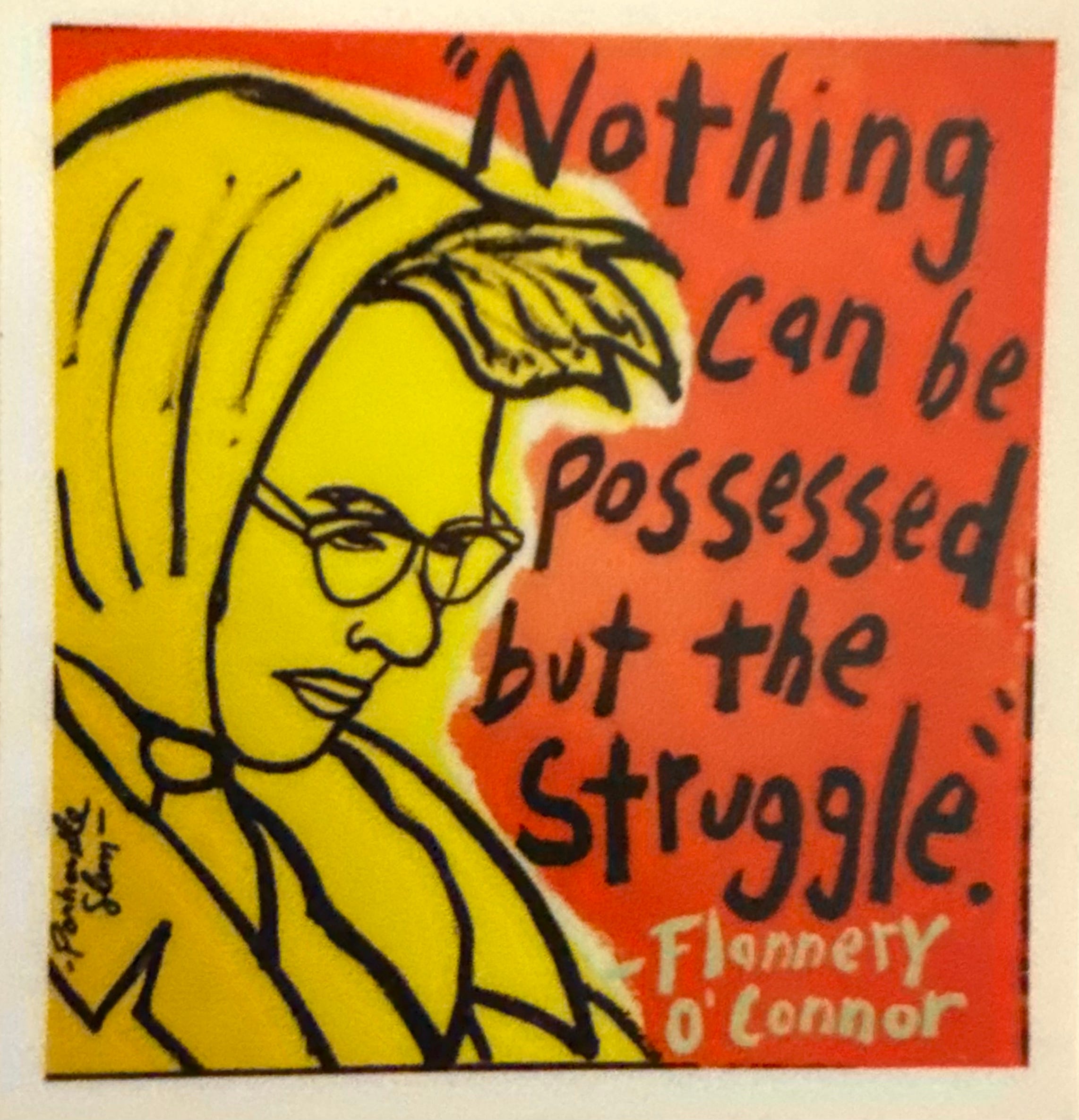
This afternoon in the childhood home of Flannery O’Connor on E. Charlton Street in Savannah, I came across a sticker with a line drawing of O’Connor in a headscarf with a quotation from her Prayer Journal: “Nothing can be possessed but the struggle.” Then barely twenty-one years old, the young O’Connor was referring to her creative work. As soon as they are finished, works of art are given away. Their fulfillment is identical with their dispossession. Works of art only become completed when they become offerings. The same is true, I think, of selves: ours only become who they really are when they are given away.
I say this as if I know from experience because I have done it, but I haven’t, and I don’t. I trust O’Connor knows this far better than I do. We are all, of course, wayfarers en route to becoming who we are. I have been fortunate enough over the last few days to witness in the faces of Fay and Oliver and Steve, in the life and work of O’Connor, and in many others, the odd and unpredictable appearance of improbable joy, not simply because they are people who have had the courage to confront the darkest parts of our common and our particular existence. To confront evil is not easy, which is why robots cannot do it. It is the most serious human challenge there is, and those who take vows of baptism are expected to promise to renounce it, which implies that they are able to identify and confront it.
But more terrifying than confronting evil is reckoning with good. Evil, after all, is merely a privation, an absence, a lack. Good is a substantial mystery, it exists, and it is incomprehensible. In one of her lesser-known works, an introduction to A Memoir of Mary Ann, O’Connor writes that
Most of us have learned to be dispassionate about evil, to look it in the face and find, as often as not, our own grinning reflection with which we do not argue, but good is another matter. Few have stared at that long enough to accept the fact that its face too is grotesque, that in us the good is something under construction. The modes of evil usually receive worthy expression. The modes of good have to be satisfied with a cliché or a smoothing-down that will soften their real look. When we look into the face of good, we are liable to see a face like Mary Ann's, full of promise.
Confronting evil takes immense courage, but less courage than confronting good. Over the last I-don’t-know-how-many miles, I have encountered no significant personal incarnations of this thing we are calling “Christian Nationalism,” not because it isn’t real (it definitely is). What I have encountered more than I was prepared to expect are those “invisible molecular moral forces that work from individual to individual,” “hidden” lives, “faces of good.” It is just possible that we choose to be terrified of the threat of Christian Nationalism—and therefore clueless as to how to combat it—because it is far more terrifying to admit the more ubiquitous, yet less visible, reality of good. The former seems to give us license to do nothing; the latter commits us to participating voluntarily in the ongoing self-diffusion of goodness.
One thing I do know from experience of multiple encounters with them is that genie-souls do tend to induce convergences in a manner totally consistent with the idea that good is self-diffusive and tends to communicate itself. And those convergences, at least potentially, are all over the place.
Yes, Fay says at the round table at Green Bough, they are everywhere.
This is apparently a slight misquotation, based on a French translation of a letter to Mrs. Henry Whitman in 1899 rendered back into English. But no matter; the sense is the same.