

Backpacking with A Deeper South
What happens when you find yourself in the middle of a head-on collision

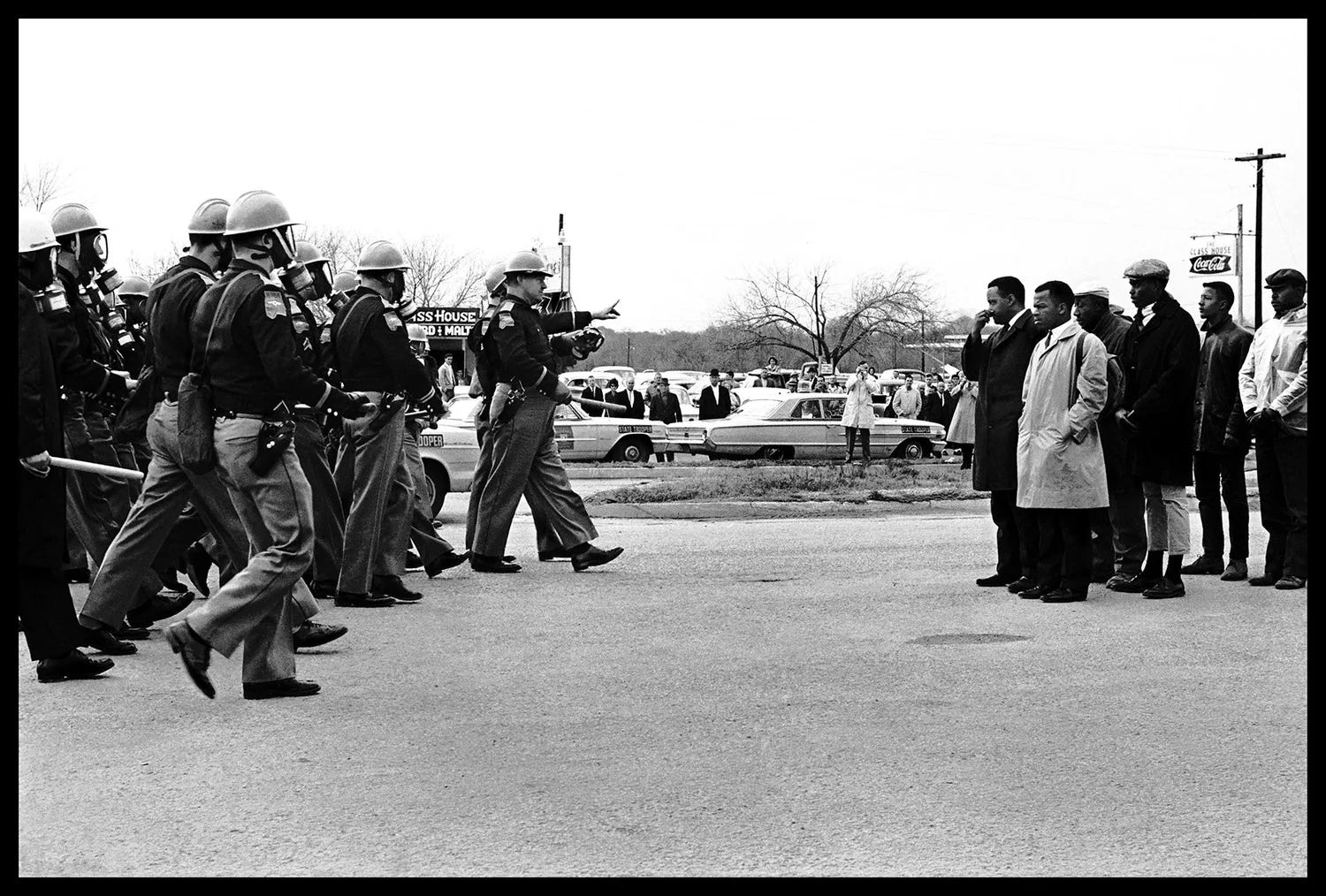
I’ve been thinking about this image a lot lately.
Called “Two Minute Warning,” it was taken on “Bloody Sunday,” 7 March 1965 by the great James “Spider” Martin, a photographer for the Birmingham News who encamped with the Movement in Alabama for a month in early 1965, from the killing of Jimmie Lee Jackson in Marion in February to the end of the March to Montgomery on the Feast of the Annunciation, March 25th.
The famous image is of an encounter poised on knife’s edge, and I scarcely need to spell out why it is so especially relevant in January 2026. The power-dynamics within the image are all-too familiar at the moment: the image is weighted to the left side, suggesting the disproportion between state power and non-violent resistance, i.e., the tactics of “massive retaliation” favored by white segregationists and, mutatis mutandis, the current US Administration. This uneven weighting of the frame means that the middle section of the photograph is not exactly the middle, but slightly to the right. But it is that section—the locus of potential action—that carries the uneven weight of the whole image. The few yards of empty space of US 80 between Alabama State Troopers on the left and marchers from SNCC and SCLC on the right presage an encounter of historic consequence. Beyond those few feet of asphalt, anonymous onlookers and amateur photographers stare imploringly across that vacant margin. Unknowingly, they look into Spider Martin’s lens as if some answer might be found there. All the spectators pictured in the background are all white, hands in pockets (both like and unlike Lewis himself), gazing across the protective barrier of Alabama State Trooper vehicles (except, of course, for the two intrepid photographers, who look into the scene in a different way.) They also seem to interrogate us, the viewers of the image: will we be anonymous spectators, too? To what illusions of protection will we choose foolishly to entrust our own hopes?
That empty space holds, in that moment, a terrible tension. What will unfold in those few feet of US Highway in the ensuing two minutes will determine, forever, the lives of those depicted here. But it will also determine, forever, the future history of the United States.
The contrasts in the image highlight the jarring oppositions between belligerents in a contest for an American future: forward motion on the left, holding fast on the right. White on the left, Black on the right. Violence and non-violence, power and powerlessness, force and persuasion, oppressor and oppressed. What took place two minutes later (or less, since the Alabama authorities felt no compulsion to keep their word) we all know now. Standing beside John Lewis, Hosea Williams knew already: he casually but portentously holds his nose as if in anticipation of the noxious fumes of tear gas to come, or at the stench of moral rot in the air. The story is so familiar because so predictable, so characteristic of a chronic American impatience with non-violence. We often tend to think history is driven by some blind force of inevitability, but Bloody Sunday did not have to turn bloody. It was a choice.
Major John Cloud of the Alabama State Patrol—haughty index finger raised at the marchers, his billy club poised suggestively as a totemic instrument of masculine power—called out to the marchers, telling them to turn back. It is now one of those great ironies of history, intelligible really only in retrospect, that the wrong group was being told to turn back. The distance between the toe of Cloud’s left Oxford shoe and the right toe of Hosea Williams’s measures the distance between American possibility and American reality. Each inch marks the possibility for a metanoia, a turning-around, each inch an opportunity refused. It is not the marchers who needed then to turn back and disperse, but the State of Alabama. Dr. King had written two years earlier from Birmingham City Jail that “freedom is never voluntarily given by the oppressor; it must be demanded by the oppressed.” About 1500 years before that, St. Augustine wrote that the lust for domination is so comprehensive and self-destructive that it ends up dominating those who practice it—so much so that one would voluntarily choose his own bondage to that lust, over genuine freedom from it.
The most arresting figure in the image is that of John Lewis, then barely twenty-five years old, in a necktie, tan trench coat, and backpack. The future nineteen-term Congressman from Georgia’s 5th District was in 1965 the Chairman of the Student Nonviolent Coordinating Committee (SNCC). He would suffer a skull fracture shortly after this iconic photograph was taken, and would bear scars from the incident for the rest of his life. His outfit for that day in Selma became so iconic that Lewis wore a recreation of it for appearances at San Diego Comic-Con from 2015-2017, when he led a march of over 1,000 children from the room where he spoke to the stall in the book hall where he signed copies of the three volumes of his graphic novel, MARCH.
Like any truly great photograph, there is enough in this one image to go on for hours or days, which would be worth doing. But what has held my attention for the last year or so has been the backpack that John Lewis is wearing. I know that whatever power of spirit enabled John Lewis to hold his ground in the face of certain doom, wailing billy clubs and swirls of tear gas, was an internal motive force, the very definition of fortitude that was for Lewis a habit of life and not simply one exceptional moment of heroic courage. The backpack he wears is a testament to his practical foresight: he expected that he would be put in jail for a while, so he packed something to eat, something to read, a toothbrush, and toothpaste. But for me it is also a kind of avatar for the encouragement of others that he must have needed to carry with him in order to withstand the brutal onslaught that he knew was to come. I wondered what was inside that peculiar and consequential piece of luggage. In an interview for Time in 2017, Lewis talked about that backpack:
But he did not mention to Time what those two books were. Surely, I thought, they held some clue as to what Lewis was thinking about then, some idea of the intellectual universe his particular star was orbiting in at the time. I thought they might provide insight into some of the ideas that drove him—and other marchers as well—to put their lives on the line. Ideas that might still be beneficial to us.
If he withheld it from Time. he did reveal to others which two books he took for the journey: The American Political Tradition by Richard Hofstadter, and an unnamed book by the Trappist monk Thomas Merton. It is a curious syllabus for a protest march, but this particular intellectual intersection may be a lot more fertile than it may seem.1
In interviews, Lewis did not specify which of Merton’s books he carried with him in his backpack. I have read differing accounts that identify the book as New Seeds of Contemplation (1962), or as his memoir The Seven Storey Mountain (1948).2 In theory it could even have been Seeds of Destruction (1964), whose subject matter aligns more with the circumstances of the Selma movement.3
But it’s the intersection of the two books I can’t quite get out of my head, and—if they were that significant for Lewis—probably shouldn’t. While it’s logical to put Seeds of Destruction in conversation with The American Political Tradition, it is more provocative, if counterintuitive, to put the latter in the same room with New Seeds of Contemplation. What could the contemplative life have to to with American politics? I am generally a believer that whenever one is tempted to ask, “yeah, yeah, but what does this have to do with X?” the answer is almost certainly “not nothing.”
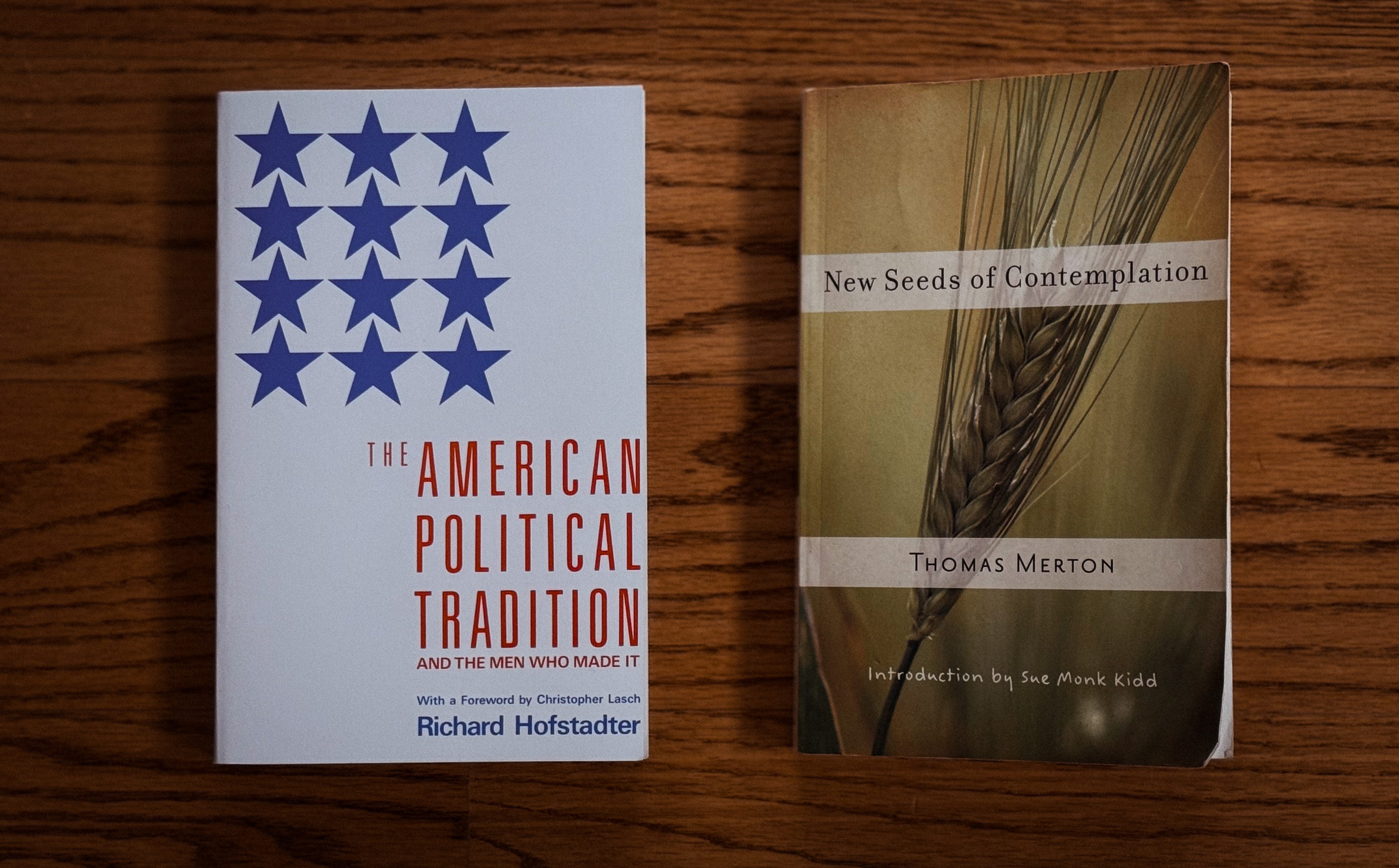
The weirdness of that question and of the juxtaposition of the two books may be a clue as to what is missing from contemporary political imagination (and theological imagination). That we would instinctively want to segregate the contemplative life from American politics is one very good reason why we should consider imagining them together.
Hannah Arendt famously identified one fundamental quality of fascist or authoritarian regimes as their will to dehumanize its subjects. She wrote that “The essence of totalitarian government, and perhaps the nature of every bureaucracy, is to make functionaries and mere cogs in the administrative machinery out of men, and thus to dehumanize them.” Dehumanization, it is worth pointing out, is not just a feature of totalitarian regimes but is “perhaps the nature of every bureaucracy.” It is much harder to dehumanize someone whom you imagine to be created in the image and likeness of the living God than someone you imagine simply to be as a something, mere matter, or a ‘monster.” So perhaps they are not that separate at all: the contemplative strain in political imagination could, at least, prevent us from such functionalizing of human being.
I have sometimes described A Deeper South as the result of having found myself standing in the middle of an intersection at the moment of a head-on collision between Flannery O’Connor, St. Augustine, and James Baldwin. But intersections and potentially generative intersections of this kind are far too provocative and life-giving to be kept to oneself. And Lord knows the present moment calls for something—anything—in the direction of a more concerted effort towards putting together things and people that do not seem on the surface to belong together. An effort, that is, towards the recognition of shared human dignity during a regime for whom the very concept of “humanity” is an inconvenient obstacle.
Which is why I want to introduce a new shared adventure: BACKPACKING with A DEEPER SOUTH, a six-week online gathering in which you and I get into the same room with Thomas Merton and John Lewis and Richard Hofstadter. What might come of such a get-together? Who the hell knows? But I do know that it will not be boring or a pointless waste of your time. I am certain some unexpected guest will make a surprise appearance and join the conversation. I can almost guarantee that Augustine and Baldwin and O’Connor will show up; they always do.
Starting Sunday February 8, probably 8:00ish ET, we will meet once a week via zoom to talk together, and see each other’s faces. I will share the details later,4 but for now know this: I really want you to consider joining this conversation, because I strongly believe that the current discourse around American political culture—especially as it involves religious, particularly Christian, life and thought—is woefully under-resourced. American Christianity, such as it is, is deep in the shitter right now, which may be for the best. The latest manifestation of the culture of death in the form of American Christian Nationalism is hopelessly moribund. It’s the equivalent of a Thomas Kinkade knock-off painting of Jesus laying hands on Donald Trump.5 Why settle for Thomas Kinkade when you can have Caravaggio?6
I believe the broadly catholic Christian Tradition (which is both what I know least poorly and the faith to which I adhere) has much, much more to say about this present moment than just the Beatitudes. The Beatitudes—so eloquently complex in their deceptive simplicity—are enough on their own, I know, but as my friend Stanley Hauerwas says, “because it is so basic, we can lose any sense of the extraordinary nature of Christian beliefs and practices." I do not want us to lose that sense, especially right now. It does not make any difference to me if you are Christian or not: we all have something to learn from 2000 years of reflection on the extraordinary simplicity of the Christian mystery and its implications for this, and every, moment. This conversation demands all people of good will and in good faith, not simply people who identify or used to as Christian. I know for a fact that Rav Abraham Joshua Heschel has a very important part in this conversation as well.
I do not have the answers to anything, but I have an idea of where to find out what the good questions are. So I am inviting you into a vision of how to be an engaged citizen and also (possibly even because) a serious religious or even spiritually-minded person7 through conversation with Thomas Merton, John Lewis, Rav Heschel, and others. If you are interested in joining, please send me a message or email me:
In any case, please share this with anyone you think might want or need it:
I warmly invite you to join the chat, which starts now:

In the meantime,
Richard Hofstadter was an influential American historian at Columbia, where Merton had been a student a decade earlier. That tenuous connection is about the only thing that links the two authors. Merton converted to Catholicism in his twenties, and joined the Trappist community at the Abbey of Gethsemani in Kentucky, and wrote prolifically for a wide audience, an unusual avocation for a member of the cloistered Order of Cistercians of the Strict Observance.
This the account proffered by no less than President Bill Clinton at his eulogy for Lewis in Atlanta in 2020, and appears to represent the consensus on the matter.
Lewis’ relationship to Merton goes beyond Selma, however. The two men never met in person, but Lewis regularly carried a volume of Merton with him during various direct-action engagements. In any case, Merton’s influence on John Lewis was far from marginal or episodic.
We will discuss a short, non-onerous reading to position the conversation. I will tell you now that this part is not required. Homework is a bonus; the important part is your presence.
You are a grown person, so I should not have tell you that you should never settle for a Thomas Kinkade anything, and if you seriously are attracted to a Thomas Kinkade rip-off, then, I am sorry. There is something wrong with you. Someone should have told you before now. I love you anyway.
I mean:
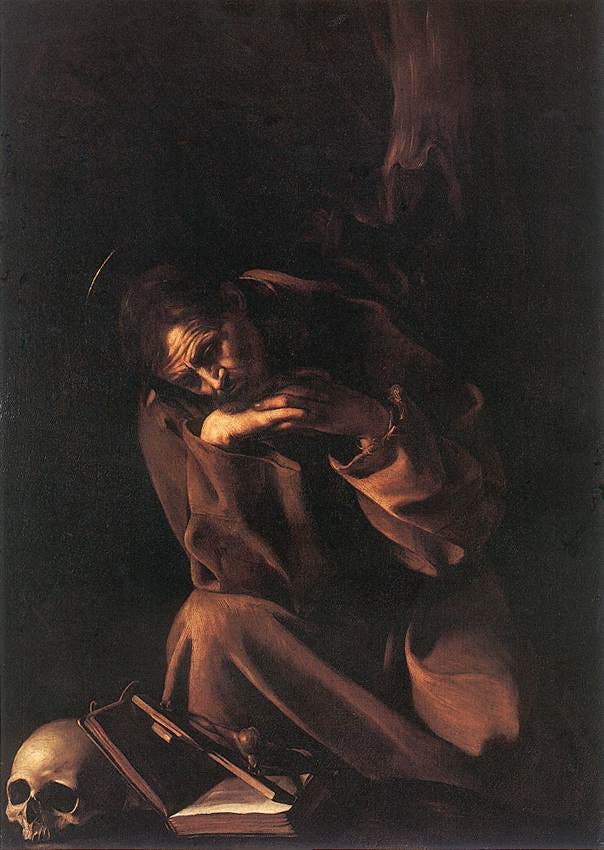
We are definitely going to be talking about St. Francis, too.
I know the term “religious” is off-putting to some, for very good reasons, but I am not personally ready to give up on it. Hell, I don’t care what you call it or yourself; if you can sense some problem and aren’t satisfied with doing nothing about it, you are most welcome to join in, and we would be honored to have you.
Fantastic angle on the backpack as avatar for internal fortitude. The idea that we instinctively segregate contemplative life from politics is exactly why they belong together feels spot-on, especially now. I always wondered about the Hofstadter-Merton pairing too, seemed like an odd combo until framing it as resistance to dehumanization. Will defintely be thinking about thisfor a while.